Table of Contents
How Free Books Are Helping Children Get Ready to Learn
No one could have imagined the impact of Dolly Parton’s Imagination Library on children around the world. When Dolly Parton launched the Imagination Library in 1995, her goal was simple: give children access to books and help them discover the joy of reading.
What began as a small effort in Parton’s home county of Sevier County, Tennessee, has grown into one of the world’s largest early-childhood book-gifting programs. Today, Dolly Parton’s Imagination Library provides free, age-appropriate books to children from birth through age five, regardless of family income.
But the program is about more than putting books in mailboxes.
Research increasingly suggests that the Imagination Library can help create stronger home literacy environments, encourage children to engage with books, and help prepare young students for kindergarten and beyond.
For schools and educators, the program offers an important lesson: academic readiness starts long before a child walks into a kindergarten classroom.
What Is Dolly Parton’s Imagination Library?
Dolly Parton created the Imagination Library in honor of her father, who was unable to read or write. Her own experiences growing up in a large family in East Tennessee helped shape her belief that every child should have access to books.
The program mails one carefully selected book each month to enrolled children from birth through age five. The books are delivered directly to the child’s home and are free to families, regardless of income.
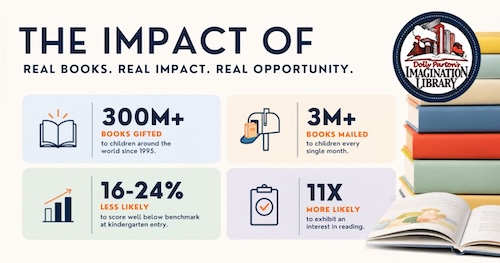
The program has expanded far beyond Tennessee. It now operates through local partners in the United States, Canada, the United Kingdom, Australia and the Republic of Ireland. More than 300 million books have been distributed through the program.
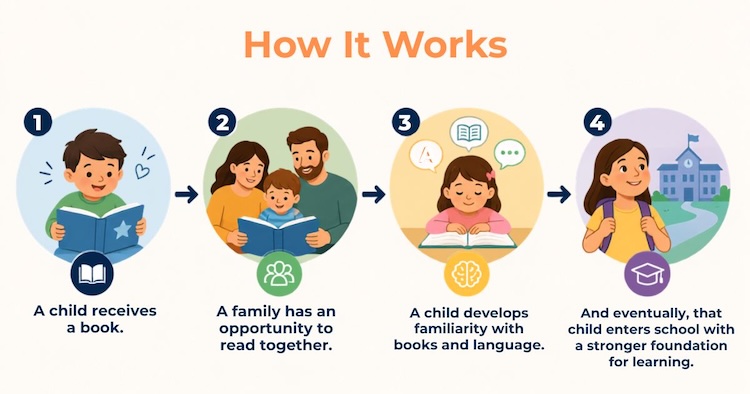
The model is intentionally simple:
A child receives a book.
A family has an opportunity to read together.
A child develops familiarity with books and language.
And eventually, that child enters school with a stronger foundation for learning.
The Imagination Library Is Making a Difference
The popularity of the Imagination Library is clear, but researchers have also been studying whether participation is associated with measurable differences in children’s literacy development.
The evidence is encouraging.
Children Can Enter Kindergarten More Prepared
One of the most important questions for educators is whether experiences before kindergarten translate into stronger school readiness.
A 2017 study published in the Journal of Applied Social Science examined 2,731 children entering kindergarten in the Syracuse City School District. Researchers compared children who had participated consistently in the Imagination Library for at least three years with children who had not.
READ MORE: Evaluating the Impact of The Imagination Library Program
The researchers found that a significantly higher percentage of children who consistently participated in the program were considered ready for kindergarten. The relationship remained after researchers controlled for key demographic factors.
That’s significant because kindergarten readiness isn’t simply about knowing how to read. Early literacy skills, including recognizing letters and understanding how print works, provide important building blocks for future reading.
Colorado Provides More Recent Evidence
A 2025 evaluation of the Imagination Library of Colorado provides another encouraging example.
Researchers with the Colorado Evaluation & Action Lab partnered with school districts to compare children who participated in the program with demographically similar children who did not.
The results showed that Imagination Library participation was associated with a 0.13 standard deviation higher score on the DIBELS assessment at kindergarten entry.
The evaluation also found that participating children were 16% to 24% less likely to score “well below benchmark” on DIBELS, an indicator of potential significant reading difficulty.
The researchers described the findings as evidence suggestive of a positive causal effect on kindergarten readiness.
Importantly, the study did not find statistically significant effects across every measure. For example, there was no effect on the Language or Literacy domains of the Teaching Strategies GOLD assessment. That nuance matters: the research supports the program as a promising early-literacy intervention, but it does not mean that receiving books alone guarantees later academic success.
The Biggest Impact Starts at Home
One of the most profound impacts of Dolly Parton’s Imagination Library is that it doesn’t happen inside a classroom.
It happens around kitchen tables, on couches, in bedrooms and wherever families read together.
The Imagination Library’s own review of more than two decades of research found consistent evidence that participating families reported:
- Reading aloud more often
- Feeling more comfortable reading with their children
- Having more children’s books in the home
- Seeing greater interest in reading among their children
- Creating stronger home literacy environments
Preschool and kindergarten teachers and community partners have also reported positive perceptions of the program and its effect on book ownership and literacy practices at home.
That is an important distinction.
The program isn’t simply giving children something to read. It is helping make reading part of everyday family life.
New International Research Strengthens the Case
Research published in 2026 provides an even broader look at the program.
A worldwide study examined Dolly Parton’s Imagination Library across the United States, Canada, the United Kingdom, Ireland and Australia. Researchers collected information from thousands of caregivers and compared children participating in the program with children who had enrolled but had not yet begun receiving books.
The study found that children participating in the Imagination Library were more likely to demonstrate important emergent literacy skills, including alphabet knowledge and receptive and expressive vocabulary.
A companion study involving more than 86,000 caregivers examined the program’s effect on the home literacy environment. Researchers found significant differences in shared reading behaviors and children’s engagement with books among participating families.
These findings reinforce a simple idea that educators have understood for generations:
Children benefit when books are available, reading is encouraged and adults read with them.
What Can Schools Learn From Dolly Parton’s Approach?
While the Imagination Library serves children before they enter formal school, its approach offers several lessons for educators.
1. Access Matters
A child can’t develop a love of reading without opportunities to experience books.
The Imagination Library removes one barrier by making books available at no cost to families.
Schools can apply the same principle by making sure students have consistent access to engaging, age-appropriate reading materials—at school and at home whenever possible.
2. Family Engagement Matters
Literacy doesn’t belong exclusively in the classroom.
Parents and caregivers are a child’s first teachers, and simple activities such as reading together can create valuable opportunities for children to develop vocabulary, comprehension and an interest in books.
Schools can support this by providing families with reading recommendations, take-home materials, family literacy nights and simple strategies for reading together.
3. Habits Matter
The Imagination Library delivers a book every month.
That consistency matters.
Rather than treating reading as an occasional activity, the program creates a predictable rhythm that makes books part of childhood.
Schools can create similar routines through independent reading time, classroom libraries, reading challenges, book clubs and other activities that make reading a regular part of students’ lives.
4. Small Investments Can Have a Big Impact
One book may not seem like a major intervention.
But one book every month for five years adds up to a child having a substantial personal library before kindergarten.
That is a powerful reminder for educators: improving student outcomes doesn’t always require a complicated solution. Sometimes it begins by giving a child the right resource at the right time—and creating an environment that encourages them to use it.
From the Imagination Library to the School Planner
The Imagination Library demonstrates the power of giving students tools that help them develop positive habits before they need them.
Books help children build early literacy skills. School planners help students develop organization, time-management and planning habits. Both are tools designed to support students beyond a single lesson or assignment.
A well-designed school planner can become part of a student’s daily routine. Students can use it to record assignments, track important dates, set goals, organize activities and develop greater ownership of their learning. And just as the Imagination Library recognizes that children have different needs and experiences, schools can customize planners to reflect their own students, programs and priorities.
A school planner can include everything from academic calendars and assignment pages to goal-setting activities, study strategies, school policies, SEL resources and information families need throughout the year.
The larger lesson is the same: When we give students useful tools and teach them how to use those tools, we give them another way to take ownership of their education.
Building a Foundation for Lifelong Learning
Dolly Parton’s Imagination Library began with a remarkably ambitious idea: that every child should have the opportunity to own books. Decades later, research suggests that the program is doing more than distributing millions of books. It is helping create stronger home literacy environments, encouraging shared reading and supporting important early literacy skills.
For schools, educators and families, that is a valuable reminder. Student success doesn’t begin on the first day of kindergarten, or even the first day of high school. It begins with the habits, resources and experiences children encounter along the way.
Whether that means putting a child’s first book into their hands, creating a classroom where reading is celebrated, or giving an older student a planner that helps them organize their responsibilities, the right tools can help students build confidence, independence and a lifelong love of learning. And sometimes, something as simple as a book in the mailbox can be the beginning of something much bigger.
Frequently Asked Questions About Dolly Parton’s Imagination Library
What is Dolly Parton’s Imagination Library?
Dolly Parton’s Imagination Library is a book-gifting program that provides free, high-quality, age-appropriate books to children from birth through age five. Books are mailed directly to participating children each month at no cost to their families.
How does Dolly Parton’s Imagination Library work?
Local organizations and communities partner with the Imagination Library to fund and implement the program. Once a child is enrolled, they receive one free book each month until their fifth birthday. The program is designed to make reading materials readily available in the home and encourage families to read together.
How many books has the Imagination Library distributed?
Dolly Parton’s Imagination Library has distributed more than 300 million books to children around the world. The program began in Tennessee in 1995 and has since expanded internationally.
Does the Imagination Library help children get ready for kindergarten?
Research suggests that participation in the Imagination Library is associated with stronger kindergarten readiness and early literacy skills. For example, a 2025 evaluation of the Imagination Library of Colorado found that participating children had higher DIBELS scores at kindergarten entry and were 16%–24% less likely to score well below benchmark on the assessment.
What research supports Dolly Parton’s Imagination Library?
Multiple studies have examined the program’s effects on children and families. Research has found associations between participation and kindergarten readiness, emergent literacy skills, shared reading and stronger home literacy environments. Research also shows that results can vary depending on the specific outcome being measured, so the program should be viewed as one component of a broader early-literacy strategy.
Who can participate in Dolly Parton’s Imagination Library?
Eligibility depends on whether the program is available in a child’s local community. In participating areas, children from birth through age five can generally be enrolled regardless of their family’s income.
How does the Imagination Library help families?
The program helps families by putting books directly into children’s homes for free. Research has found that participating families report reading together more frequently, having more children’s books at home and seeing greater engagement with books among their children.
Can schools participate in the Imagination Library?
Yes. Schools and school districts can be involved in supporting and promoting the program in their communities. Local organizations, libraries, early-childhood programs and other community partners can also help bring the Imagination Library to families.
What can schools learn from Dolly Parton’s Imagination Library?
The Imagination Library demonstrates the importance of access, consistency and family engagement in education. Providing children with the right resources and encouraging positive habits at home and at school can help create a stronger foundation for learning.
Custom School Planners Can Help Cultivate Reading & Time Tracking Habits Early
Books are just one tool that can support student development. As students get older, tools such as school planners, goal-setting pages, assignment trackers and organizational resources can help them develop independence, time-management and planning skills. A customized school planner can bring these resources together while also giving schools an opportunity to reinforce their own academic and student-success priorities.